From the Archive · Sudanow, December 1979
“Reefs Are For Everyone”
Dr Hans Hass on the coral reefs of Port Sudan — the interview that helped set in motion the idea of protecting Sanganeb
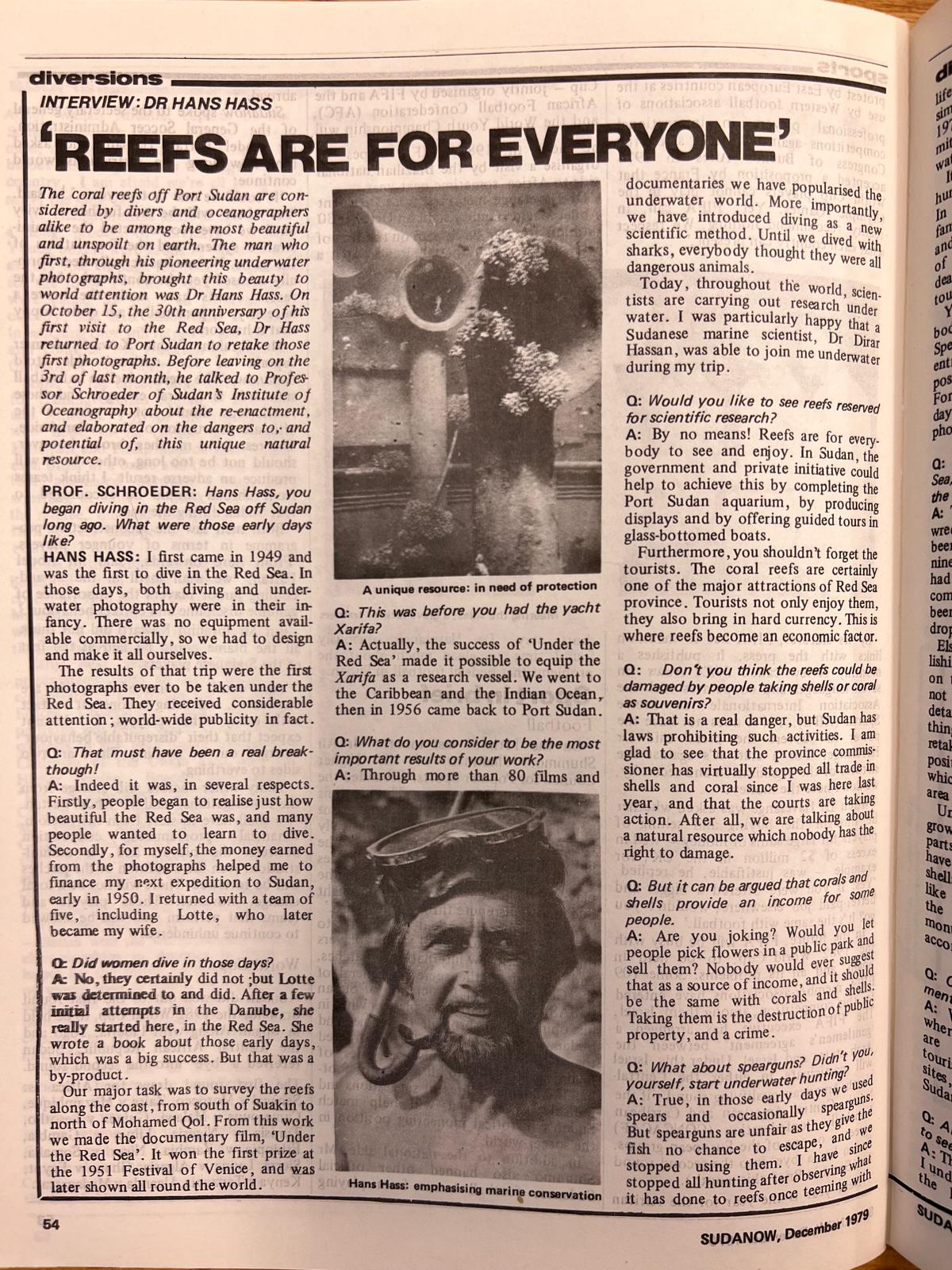
The coral reefs off Port Sudan are considered by divers and oceanographers alike to be among the most beautiful and unspoilt on earth. The man who first, through his pioneering underwater photographs, brought this beauty to world attention was Dr Hans Hass. On October 15, the 30th anniversary of his first visit to the Red Sea, Dr Hass returned to Port Sudan to retake those first photographs. Before leaving, he talked to Professor Schroeder of Sudan’s Institute of Oceanography about the re-enactment, and elaborated on the dangers to, and potential of, this unique natural resource.
Prof. Schroeder: Hans Hass, you began diving in the Red Sea off Sudan long ago. What were those early days like?
I first came in 1949 and was the first to dive in the Red Sea. In those days, both diving and underwater photography were in their infancy. There was no equipment available commercially, so we had to design and make it all ourselves. The results of that trip were the first photographs ever to be taken under the Red Sea. They received considerable attention — world-wide publicity, in fact.
That must have been a real breakthrough!
Indeed it was, in several respects. Firstly, people began to realise just how beautiful the Red Sea was, and many people wanted to learn to dive. Secondly, for myself, the money earned from the photographs helped me to finance my next expedition to Sudan, early in 1950. I returned with a team of five, including Lotte, who later became my wife.
Did women dive in those days?
No, they certainly did not; but Lotte was determined to, and did. After a few initial attempts in the Danube, she really started here, in the Red Sea. She wrote a book about those early days, which was a big success — but that was a by-product. Our major task was to survey the reefs along the coast, from south of Suakin to north of Mohamed Qol. From this work we made the documentary film, ‘Under the Red Sea’. It won the first prize at the 1951 Festival of Venice, and was later shown all round the world.
This was before you had the yacht Xarifa?
Actually, the success of ‘Under the Red Sea’ made it possible to equip the Xarifa as a research vessel. We went to the Caribbean and the Indian Ocean, then in 1956 came back to Port Sudan.
What do you consider to be the most important results of your work?
Through more than 80 films and documentaries we have popularised the underwater world. More importantly, we have introduced diving as a new scientific method. Until we dived with sharks, everybody thought they were all dangerous animals. Today, throughout the world, scientists are carrying out research underwater. I was particularly happy that a Sudanese marine scientist, Dr Dirar Hassan, was able to join me underwater during my trip.
Would you like to see reefs reserved for scientific research?
By no means! Reefs are for everybody to see and enjoy. In Sudan, the government and private initiative could help to achieve this by completing the Port Sudan aquarium, by producing displays and by offering guided tours in glass-bottomed boats. Furthermore, you shouldn’t forget the tourists. The coral reefs are certainly one of the major attractions of Red Sea province. Tourists not only enjoy them, they also bring in hard currency. This is where reefs become an economic factor.
Don’t you think the reefs could be damaged by people taking shells or coral as souvenirs?
That is a real danger, but Sudan has laws prohibiting such activities. I am glad to see that the province commissioner has virtually stopped all trade in shells and coral since I was here last year, and that the courts are taking action. After all, we are talking about a natural resource which nobody has the right to damage.
But it can be argued that corals and shells provide an income for some people.
Are you joking? Would you let people pick flowers in a public park and sell them? Nobody would ever suggest that as a source of income, and it should be the same with corals and shells. Taking them is the destruction of public property, and a crime.
What about spearguns? Didn’t you, yourself, start underwater hunting?
True, in those early days we used spears and occasionally spearguns. But spearguns are unfair as they give the fish no chance to escape, and we have since stopped using them. I have stopped all hunting after observing what it has done to reefs once teeming with life. They are now deserted. There are simply too many divers now, and so in 1973 we formed an international committee to ban all mechanical underwater weapons.
It would be disastrous if speargun hunting were to be allowed off Sudan. In two or three years, your world-famous diving spots like the Sanganeb and Shaab Rumi reefs, or the wreck of the Umbria, would be as good as dead — and that would be the end of tourism. You have the law, so don’t let anybody take a speargun to your reefs. Spearguns should be confiscated on entry as in the Seychelles, and mere possession should be prohibited. Fortunately, though, most divers these days are more interested in taking photographs of the reefs and their fish.
What brings you back to the Red Sea, after forty years of diving all over the world?
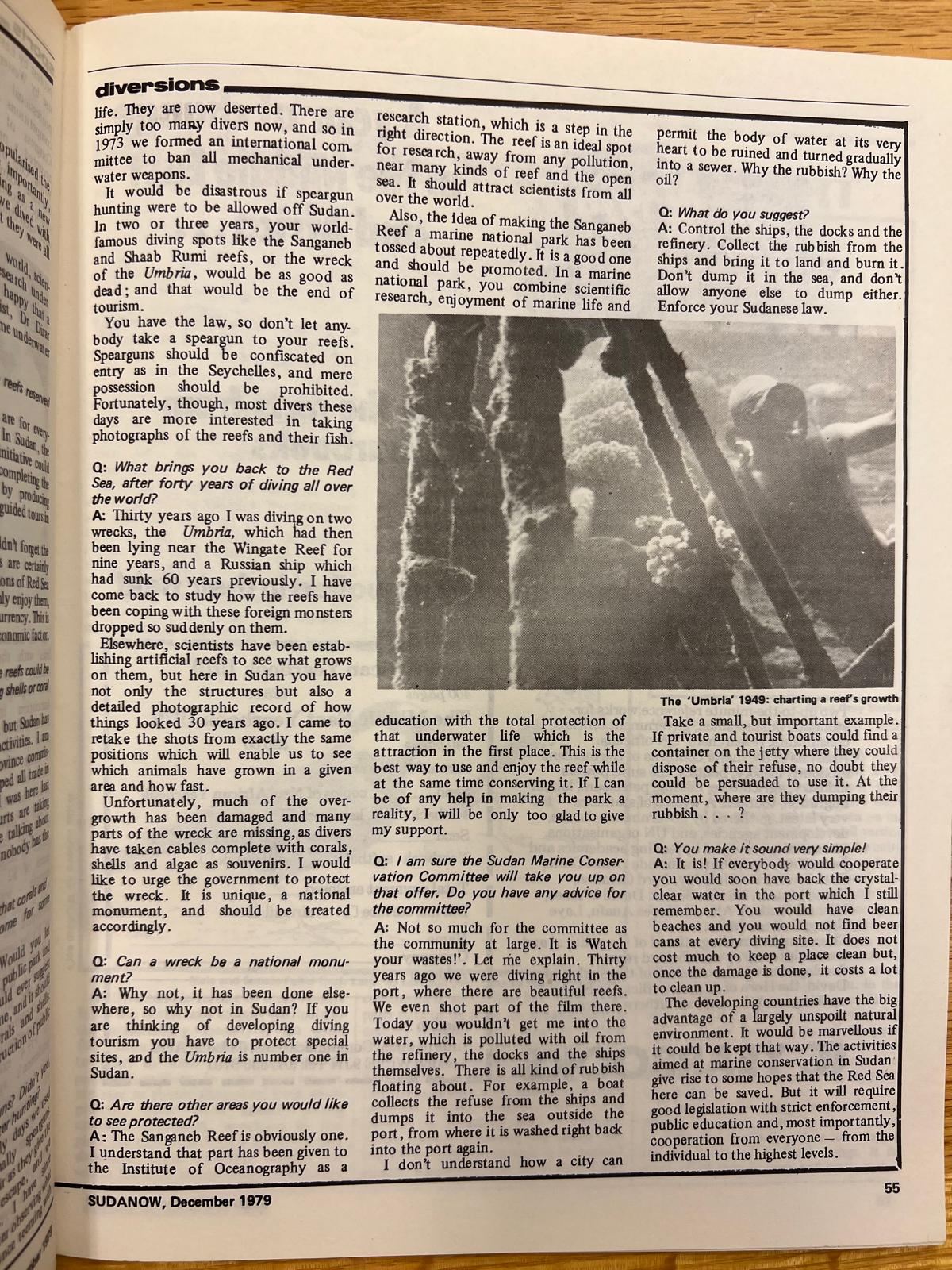
Thirty years ago I was diving on two wrecks, the Umbria, which had then been lying near the Wingate Reef for nine years, and a Russian ship which had sunk 60 years previously. I have come back to study how the reefs have been coping with these foreign monsters dropped so suddenly on them.
Elsewhere, scientists have been establishing artificial reefs to see what grows on them, but here in Sudan you have not only the structures but also a detailed photographic record of how things looked 30 years ago. I came to retake the shots from exactly the same positions, which will enable us to see which animals have grown in a given area, and how fast.
Unfortunately, much of the overgrowth has been damaged and many parts of the wreck are missing, as divers have taken cables complete with corals, shells and algae as souvenirs. I would like to urge the government to protect the wreck. It is unique, a national monument, and should be treated accordingly.
Can a wreck be a national monument?
Why not — it has been done elsewhere, so why not in Sudan? If you are thinking of developing diving tourism you have to protect special sites, and the Umbria is number one in Sudan.
Are there other areas you would like to see protected?
The Sanganeb Reef is obviously one. I understand that part has been given to the Institute of Oceanography as a research station, which is a step in the right direction. The reef is an ideal spot for research, away from any pollution, near many kinds of reef and the open sea. It should attract scientists from all over the world.
Also, the idea of making the Sanganeb Reef a marine national park has been tossed about repeatedly. It is a good one and should be promoted. In a marine national park, you combine scientific research, enjoyment of marine life and education with the total protection of that underwater life which is the attraction in the first place. This is the best way to use and enjoy the reef while at the same time conserving it. If I can be of any help in making the park a reality, I will be only too glad to give my support.
“If I can be of any help in making the park a reality, I will be only too glad to give my support.” — Dr Hans Hass, Sudanow, December 1979, on the proposal to make Sanganeb a marine national park
I am sure the Sudan Marine Conservation Committee will take you up on that offer. Do you have any advice for the committee?
Not so much for the committee as the community at large. It is ‘Watch your wastes!’. Let me explain. Thirty years ago we were diving right in the port, where there are beautiful reefs. We even shot part of the film there. Today you wouldn’t get me into the water, which is polluted with oil from the refinery, the docks and the ships themselves. There is all kind of rubbish floating about. For example, a boat collects the refuse from the ships and dumps it into the sea outside the port, from where it is washed right back into the port again.
I don’t understand how a city can permit the body of water at its very heart to be ruined and turned gradually into a sewer. Why the rubbish? Why the oil?
What do you suggest?
Control the ships, the docks and the refinery. Collect the rubbish from the ships and bring it to land and burn it. Don’t dump it in the sea, and don’t allow anyone else to dump either. Enforce your Sudanese law. Take a small, but important, example: if private and tourist boats could find a container on the jetty where they could dispose of their refuse, no doubt they could be persuaded to use it. At the moment, where are they dumping their rubbish…?
You make it sound very simple!
It is! If everybody would cooperate you would soon have back the crystal-clear water in the port which I still remember. You would have clean beaches and you would not find beer cans at every diving site. It does not cost much to keep a place clean but, once the damage is done, it costs a lot to clean up.
The developing countries have the big advantage of a largely unspoilt natural environment. It would be marvellous if it could be kept that way. The activities aimed at marine conservation in Sudan give rise to some hopes that the Red Sea here can be saved. But it will require good legislation with strict enforcement, public education and, most importantly, cooperation from everyone — from the individual to the highest levels.
Source & Acknowledgements
- Originally published in Sudan Now, Khartoum, December 1979 — at the time issued by Sudan’s Ministry of Culture and Information.
- Sourced and shared by Ms. Issraa El-Kogali.
- Archival scan courtesy of the Mahmoud Salih Sudan Collection, University of Bergen.